Final Presentation
I enjoyed this project because it dealt with kids. It was also something different after doing projects based on our studied subcultures. At first I didn't really know where I was going with things, which made designing it harder. I had a strong concept but really weak execution, something that I still need to work on. In the end, I really like where it went. I learned that designing simple things is actually really hard and making it work is also hard. I'm also not strong at choosing colors and that's something I will explore more.
Showing posts with label User Experience. Show all posts
5.09.2011
5.05.2011
"Sculpt Your Own Story" Progress
Concepts:
Round l:
I also had rendering drawings which were basically just line drawings of the sculpture.
Round 2:
This was what I showed the Nelson for a concept brief, which was more about concept than design.
Round 3:
This was what I showed for that in class testing day with our class.
Round 4:
What I showed for the testing day with kids. They had really great feedback like size how I should approach it more.
Round 5:
And then just a ton of iterations:
5.04.2011
Readings 05.06.11
Designing for Children: Designing for a younger audience is a lot harder than what people would think. The design should inform, delight, and satisfies. Producing a design that caters to a wide age range is also difficult because you want to keep the older kids engaged but you don't want to leave out the younger ones that hasn't fully understand complex ideas. The designs should not speak down to the kids or make them feel any smaller or younger than they are. I feel like my idea caters to all ages since it is so open-ended, the kids can answer the questions however they want.
Map design: When designing maps, there are 5 things to keep in mind: decide on concept before making, hierarchy of elements, simplicity until you can't take out anything else, must function well, and use emotion to design so that the emotion can be conveyed to the users. I feel like my map kept those all in mind but while I was making it, I did things more backwards than forwards. I didn't have a concept to start with and I kept it simple from the beginning and kept adding instead of keeping it complicated and taking away.
Play as Research: Iterative design is important when creating for audiences that will interact with the artifact, such as games. It allows you to see things you missed when you first design it. With our project, we had a user testing day and everyone benefitted from it. I saw what was wrong with my design and how to improve it. Testing it also made the project "real" and that it should cater to the audience the best way possible.
Map design: When designing maps, there are 5 things to keep in mind: decide on concept before making, hierarchy of elements, simplicity until you can't take out anything else, must function well, and use emotion to design so that the emotion can be conveyed to the users. I feel like my map kept those all in mind but while I was making it, I did things more backwards than forwards. I didn't have a concept to start with and I kept it simple from the beginning and kept adding instead of keeping it complicated and taking away.
Play as Research: Iterative design is important when creating for audiences that will interact with the artifact, such as games. It allows you to see things you missed when you first design it. With our project, we had a user testing day and everyone benefitted from it. I saw what was wrong with my design and how to improve it. Testing it also made the project "real" and that it should cater to the audience the best way possible.
4.21.2011
4.05.2011
Final Be My SWEEP
Final presentation
This project reminded me of last semester and my PSA for the poverty simulation with Joseph. I felt like my concept was strong but execution was a bit weak. I learned that tailored communication can't be so tailored that the public is not included. My tags are in a public area so I can't just talk to hikers alone. I did include a definition to help those not familiar with the term sweep. Overall, this project was another project for me. I did learn things but I felt like I could always do more.
Be My SWEEP Progress
Research:
1. why is this issue pertinent and timely?
2. what are its causes?
3. what are detrimental effects to individuals? to greater society?
4. what are preventative measures?
5. how does this issue relate to your sub-culture?
6. what organizations have a vested interest in this issue?
7. what organizations have a vested interest in your sub-culture?
8. what public service campaigns have previously addressed this issue?
Female Coders – health awareness – lack of sleep/stress
1. According to the talks we had last class, a big thing in the news right now is sleep related issues. This is a problem that stays in society and if it doesn’t affect one person, it affects another. There’s a lot of articles talking about sleep and how to get the best one or what to do if you can’t get enough sleep. Stress and insomnia are big health concerns as well that could affect any coding person.
2. Health takes a back seat in people’s lives when they get too busy. The people that were interviewed were students, so they focused more on schoolwork and their social life, possibly ignoring their health. They probably aren’t watching what they are eating either since fast food is at hand’s reach, which adds to their chances of being unhealthy.
3. Stress causes physical illness as well as emotional and mental problems. It triggers insomnia, headaches, personality changes, anxiety, and depression. It could also cause hair loss, pain in muscles, outbreaks in skin, and if serious, heart problems. Insomniacs feel tired during the day and their energy level is low. In the bigger scope, this could affect people around them and their social interaction.
4. It’s best to get as much sleep as possible, 8 hours by most sources. It also helps to take little naps in between the day to feel better. If sleep is not possible at that moment, they could take tiny breaks to relax and refocus. Having a place or activity to take their minds off of things for just a little bit will help with stress.
5. Coders spend a lot of time on the computers writing code and probably don’t get enough sleep. Memorizing lines of codes also puts stress on the brain so it’s best to relax when they can. Some of them probably experience insomnia of different degrees without realizing it as well.
6. There’s a ton of medical organizations that research sleep like the American Sleep Association. There are also groups like Sleep Disorders Support Group and American Academy of Neurology. There’s also the World Health Organization that focuses on health in general but also on stress and sleep.
7. Apache Software Foundation was trying to get more female coders into the field in 2005. Organization for Transformative Works focuses more on fan made products but they have their own group of female coders that they really support and encourage others to join.
8. Agnesian Healthcare did a PSA on getting more sleep in 2009. They made a “sleep” energy can and put it against text that said “get more energy”.
Bike Commuters – DIY tips – sustainability
1. People are being conscious of the environment lately and they like the thought of reusing things they already have. People are being more frugal as well so they are wiser on how they spend their money.
2. The economy has gone down and people have been losing their jobs or are not as financially stable as they use to be. Because of this, they are finding new ways to recycle objects and make things last longer.
3. People save more money by doing things themselves as well as finding different ways of approaching problems. They also learn skills that were lost when machines started doing work for us. In society, it preserves the environment more because there will be less trash. The economy won’t go up as much since people will be reusing things rather than buying new products.
4. Tips on how to prolong their bikes, what to look for when buying new things for them to last longer, and care needed for longer lasting equipment would address the sustainability of bikes.
5. Bike commuters are environmentally conscious. They commute instead of using gas so they would like making their bikes longer lasting. If tips were provided, people just starting to ride their bikes more will find it helpful.
6. There are a lot of groups dealing with sustainability but it’s more in the sense of the environment as a whole and ways to recycle and reuse like Center for a New American Dream, Climate Project, World Changing, etc.
7. There are various bike groups like the Network of Employers for Traffic Safety that targets safety for bike riders. Many other groups like the Humboldt Bay Bicycle Commuters Association gear towards this subculture more.
8. There hasn’t been any PSA on bike sustainability. There are tips here and there but no one has really organized them to send to the mass of people as a message. There’s numerous PSA on bike riding and bike safety though.
Trail Enthusiasts – preparation – health?
1. Health is always a topic that people talk about. There are many articles about taking care of one’s self and the effects of being unhealthy.
2. People gets lost in their daily lives that they don’t realize they should put their health somewhere on top. They tend to overlook the tiny details because it isn’t as important as the bigger picture.
3. People could get hurt or seriously injured. If serious, it could lead to complications of internal organs. It wouldn’t do much to the greater society since it’s more of an individual issue. If anything, it just lowers or raises statistical rates.
4. They could watch what they are doing, eat right, and be prepare in case an accident happens.
5. Hikers go out a lot and tend to be prepared for worst-case scenarios. They know what they are doing but sometimes they can overlook little things. They might not also be aware on how to handle accidents during the hike.
6. There are many health organizations like the World Health Organization and the American Public Health Associations. There’s also organizations focused on just the heart, like the American Heart Association.
7. Trail organizations are based on states but nation wide, there is the American Hiking Society. In Missouri and Kansas, there is the Trail Masons Association, Earth Riders Trails Association, and the Northland Trails and Greenways.
8. There is a small PSA for hiking and camping for feminists. It seems as though this is geared towards more amateur hikers because there’s a picture of a tip hung on the trail at a dangerous point to remind hikers to avoid this certain thing. Besides this one, there are just a ton of compiled lists of helpful tips and hints to remember about, none of which are designed.
Concepting:
Design:
Final for guest presentation:
3.22.2011
Compare/Contrast Readings
In all four readings, the writers aim at designing a system for a specific audience. Meggs and McCoy's readings both focused on communication for a certain type of group, which is the idea of tailored communication. Using imagery and text that only that specific group recognizes targets them and makes them the key consumers. McCoy talked about how things are changing in terms of design and how it went from targeting everyone to targeting only certain groups. This way, people are more prone to consume things rather than overlook it. At the same time, the last two readings was more of making a global brand. In the reading Local Lingo, she talks about companies being located in many different spots around the world. Even though the messages are targeted towards a particular country, it still manages to incorporate other countries as well. The Coke article was the most interesting for me. I like that he doesn't use the word "design" because I feel like there is more to design than just "design". He was basically redesigning Coke for the masses but he changed each country up to fit their lives. Between the articles, tailored communication is used a lot to target specific groups of people. In our project right now, that is also what we are doing. I think making this project successful is whether or not it talks to our subgroup but also to the people who might not understand it as deeply.
2.27.2011
Final Book
Final book
The file is really big so it might take a while to load.
This was such a fun experience making. I loved doing the research part of it and compiling the data into a book. It was really fun talking to everyone from the hiking group. I'm proud of the book Bethany and I made. We tried to capture the hikers in the book and I think we achieved it as best as we could. I liked doing all the diagrams and figuring out how to simplify the information for people so that was one of my strengths. I'm still a little weak on the aesthetics of things and working with photos and that is something I took away from working with Bethany. Overall, I'm glad for this experience and hopefully I'll get to bring the research aspect into future projects.
The file is really big so it might take a while to load.
This was such a fun experience making. I loved doing the research part of it and compiling the data into a book. It was really fun talking to everyone from the hiking group. I'm proud of the book Bethany and I made. We tried to capture the hikers in the book and I think we achieved it as best as we could. I liked doing all the diagrams and figuring out how to simplify the information for people so that was one of my strengths. I'm still a little weak on the aesthetics of things and working with photos and that is something I took away from working with Bethany. Overall, I'm glad for this experience and hopefully I'll get to bring the research aspect into future projects.
Book Making
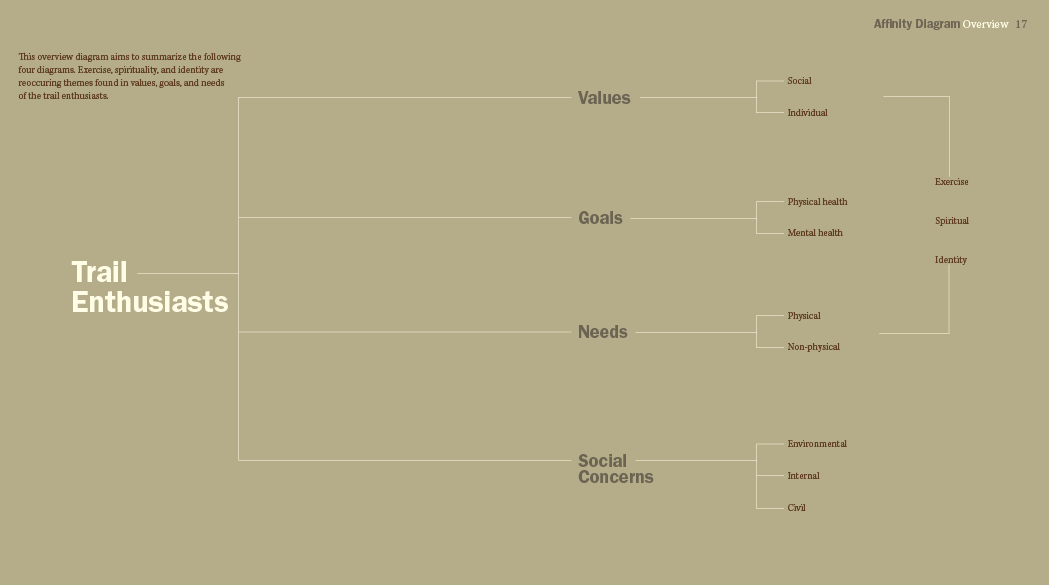
After our research phase, we started to design the book. Bethany's blog has most of what was done between us. First round we did a lot of analog:
And from there, we put them into our book layout (grid by Bethany) and fixed things around many times
Second round we made translated it into digital:
And from there, we put them into our book layout (grid by Bethany) and fixed things around many times
We also put another section in, maps, to show trails around KS and MO that are famous.
There was a lot more work in between but these were kind of the main phases.
2.23.2011
In Class Research
Pertinent and timely concerns in relation to world politics
- Egypt - uprising and protests
- Libya - same as Egypt; impact on oil prices
- Middle East in general - most neighboring countries are protesting against their government as well
- Europe's and America's reactions/thoughts/etc. to Middle East conflicts
- Somalian pirates - holding hostages, killing people, etc.
2.01.2011
Research Insights
From the interviews, the self-reporting, and the hike Bethany and I did, there are some patterns happening in terms of who hikers are as people. I did some analysis in my notes post down below but I'll summarize it here as well. The hikers all seemed laid back and very outgoing and talkative. They were all easy to talk to and very nice. Their motivation for hiking seems to be the same as well. Many did it for health while others find that its calming, peaceful, and spiritual. The ladies that I talked to all had various trail stories and how there isn't just one that they can choose as their favorite. The hikers also remember spots that are striking, either by something there that was special or the colors that were present. They all are very respectful. They love love love the outdoors and would much rather be outside than inside. They are an active group because even in summer, they find other outdoor activities to do. Of course, this is only from my point of view and I'm sure there's more that I haven't thought of yet.
Avid Hikers
My sub-culture was outdoor enthusiasts focusing on hikers but then we (Bethany and me) limited it down to just hikers. For last Friday, we had some secondary research about the gears they wear, their language, etc. We also had interviews set up, our leave behind determined, and an idea for a field research. We contacted a group to see if we can join them on their hike, but according to them, it would've been too "strenuous" for us so they didn't let us come. At the end of that class though, we found another group that allowed us to hike with them at Leawood Park on Saturday. So in the end, everything worked out pretty nicely. We also had an interview scheduled for 4 on Friday with Julie Cirlincuina. Some notes on that interview:
- Doesn't have a favorite trail because each one has its own characteristic but if she had to pick one, it'd be Konza Prairie in Manhattan, KS. It's a 6 mile hike with beautiful scenery.
- She started hiking because she needed another hobby. She doesn't like shopping anymore because after a while, they stop making cute things for you. (now I'm assuming she's in her 40s because she sounded like it and I didn't want to ask)
- Her mindset while hiking is to forget everyday life and just focus on the surrounding - sound, hear, smell, etc.
- She doesn't think about life while on a hike. The stress and everything just goes away.
- She finds hiking to be therapeutic.
- Indoors, her mind is not worried about intrusions whereas outdoors, she's more focused. Her senses are heightened and she needs to be more aware of her surroundings.
- There's a better sense of self because she's more focused inward instead of mundane things. It's also more spiritual for her.
- Hiking has improved her health and vascular stamina. She also stated again that there's a better sense of self.
- "A good day on the trail is a good day in the office."
I wanted to keep the interview short since it was a phone interview and her time seemed precious so I only asked the more "important" question. She seemed pretty open and okay with talking about everything. There were some questions that I asked her and I remember her saying, "You're actually making me think." I guess she hasn't really thought about how hiking has impacted her so that was interesting to hear.
So Bethany and me went on a hike with Julie's group, Women's Outdoor Recreation, without knowing about it. They were actually hiking with another group as well but it was coincidental that we got to talk to more ladies from the WOR group. Some notes I took of this hike:
- A lot of the members were wearing similar gears like some sort of hat (knitted and caps), a thick outdoors coat, thick gloves, hiking shoes (mainly boots of sorts), backpack, cargo pants or sweats, some had hiking sticks (the older ones), fanny packs, etc.
- They are very sociable and talkative, but not in the sense of gossiping, they were just genuinely interested in many topics.
- There were clear leaders who led the group through the trails.
- Very open people and very nice, respectful, sweet, caring. They seemed worry about Bethany and me hiking with them but they were all for it.
- There were more ladies there than men (but I'm assuming that's because they are also a part of the WOR group).
- Very relaxed group, they stopped occasionally to take pictures of the scenery. They were also really excited to be hiking and being outdoors and being a part of nature.
- They were also very funny, cracking jokes whenever possible.
- They liked challenges on the trail like trekking through the snow or crossing water.
- The whole group consisted of 20 people or so. Most of them in their 40s to 70s. They are at that age where their kids are settled down and they don't have to worry so much.
- Not even halfway through the trail yet, people were taking off their thick coats already, revealing that they wore more than one layer underneath.
- Many of the ladies were talking about their families and trips they took or ones they are planning to take. The trips seem to be to colder climates like Wisconsin, Alaska, and Colorado. This hints that they really like being outdoors and doing winter activities.
- They seemed to be animal lovers since many talked about bringing their dogs with them, but because of the snow, it was a bit difficult. Leawood Park also require dogs to be on leashes at certain areas, otherwise they would've brought their dogs.
- People walked in single file when we were on the horse trails but then they walked in groups when we were on bike trails.
- "All it takes is will."
- When someone passes them on a bike on the bike trail, they all yell "BIKE!" so that people behind them know to walk to the side.
- They plan out which trail they hike but they don't walk it before the big hike with everyone so obstacles comes as a surprise.
- The trail we went on is getting more difficult because of the creek coming up.
During the hike, I also talked to a lady named Jackie. She coordinates most of the hike with Julie (the lady I interviewed) and was super nice. I had no idea that she knew Julie so that was cool. But a few stories/facts she told me while we were walking back:
- There's usually only 6 or 7 people that comes out to a hike. The one we joined in had a really good turn out with 20 people or so.
- Every year they do a hike on the last weekend of January. Every year they hike somewhere different. Last year, it was in Michigan where the temperature was below 30.
- There's a project happening that is working towards joining all the trails around KC into a group.
- They get funding from the government to get more people into hiking since it doesn't cost a lot and it doesn't take much training to get involved.
- They don't hike much in the summer because of the hot weather. They like to hike at cooler temperature like what it was on Saturday. So in the summer, they would hike really early in the morning or go canoeing, ice skating, kayaking, etc. during the day.
- The group sometimes plans trips to take together to go hiking in another state.
- One year, they had a New Years Day hike where they all got together and hiked with really cold temperatures and then headed over to a person's house where everyone cooked different kinds of soups to share.
- They get together every year to clean up the trails. There's other groups, like the biking group and another hiking group, that takes care of different trails. The horse trail we went on wasn't taken very good care of because people stopped having horses to ride through so it's become a bit disheveled.
- There was a story she told me about them marking a trail with paint so that people knew and by the end of it, the guy was covered in blue paint and it was the type that is permanent so it was hard to get off.
- The group is trying to get younger people involved but realizes that they are busy and some find it boring. The younger people get more involved when things are indoors, like ice skating in the summer.
- The group we went with is a lot more relaxed and chill than most others. This one likes to stop and rest, whereas other groups hike continuously. She told me a story about how a few of them went hiking with the super avid hikers and couldn't keep up.
- Reasons why people were hiking involved keeping up their health and to keep their bones healthy.
A lot of information! There's more on Bethany's blog about our leave behind and our other interview.
1.26.2011
Design Research Readings
Section One Introduction: "Qualitative design research enjoys a controversial existence." This was interesting to read since it came from a first person's point of view. Christopher Ireland did a really nice job explaining what works and what doesn't when he went and researched people. Qualitative design research is learning about the people by listening to them, watching them, or experiencing their lives first hand. It was also nice to read about his experience with researching for Disney and how much positive feedback he got back from it.
Ethnology and Critical Design Practice: Ethnography, a research technique thats rooted in anthropology, is important when designing for people. It tells about the people through various factors and it's important to involve those findings into your design. Adding field studies to your design makes it more successful because you have a better understanding of the target audience and you're aiming the design at them. This whole section was mainly about the background of ethnography and how it can benefit us as designers.
Peachpit: Design research is investigating a product's or service's potential or existing users and the context of use. It uses many methods drawn from anthropology, scientific and sociological research, theatre, and design itself. It's more of a qualitative research that focuses on how and why questions more than quantitative research, which focuses more on numbers and what questions. Design research has three "rules" for conducting it: you go to them, you talk to them, and you write stuff down. There's things to not do as well as some other stuff to follow like getting consent and telling them what you are doing. There were also tips on patterns and when to detect it. A lot of the research, it seems, is about reading people and understand them through getting to know them.
Ethnology and Critical Design Practice: Ethnography, a research technique thats rooted in anthropology, is important when designing for people. It tells about the people through various factors and it's important to involve those findings into your design. Adding field studies to your design makes it more successful because you have a better understanding of the target audience and you're aiming the design at them. This whole section was mainly about the background of ethnography and how it can benefit us as designers.
Peachpit: Design research is investigating a product's or service's potential or existing users and the context of use. It uses many methods drawn from anthropology, scientific and sociological research, theatre, and design itself. It's more of a qualitative research that focuses on how and why questions more than quantitative research, which focuses more on numbers and what questions. Design research has three "rules" for conducting it: you go to them, you talk to them, and you write stuff down. There's things to not do as well as some other stuff to follow like getting consent and telling them what you are doing. There were also tips on patterns and when to detect it. A lot of the research, it seems, is about reading people and understand them through getting to know them.
Subscribe to:
Posts (Atom)