12.28.2010

12.03.2010
Final A/VOID
Final artifacts (poster (yellow), bus stop/placard (purple), motion piece(green)):
 Keynote presentation
This project has been challenging yet fun at the same time. At the beginning, we circled around ideas a lot and it took a long time to just even nail one down. Once we decided to go with the avoid idea, it was more formally challenging. We knew we wanted the split already but wasn't sure how to go about it. Then we added images and colors and different phrases. In the end, I'm satisfied with what we created. Making the presentation was a challenge of itself. It was challenging to know what to say on top of what to show at the same time. Overall, I learned so much from this project, especially how to work with a partner. I think my concept ideas are more strong now as well as formal executions. A lot of it was influenced by the partnership but it has also taught me a lot about how I think and work.

This project has been challenging yet fun at the same time. At the beginning, we circled around ideas a lot and it took a long time to just even nail one down. Once we decided to go with the avoid idea, it was more formally challenging. We knew we wanted the split already but wasn't sure how to go about it. Then we added images and colors and different phrases. In the end, I'm satisfied with what we created. Making the presentation was a challenge of itself. It was challenging to know what to say on top of what to show at the same time. Overall, I learned so much from this project, especially how to work with a partner. I think my concept ideas are more strong now as well as formal executions. A lot of it was influenced by the partnership but it has also taught me a lot about how I think and work.
12.02.2010
Presentation Readings
I do declare:
This was a good article to read. It listed bullet points and elaborated on them. Overall, presentation is all about confidence and keeping the audience engaged. The writer talks about how to do those things and how important it is that the audience keeps their interest. The person presenting should also know a few things like how to talk and what to present. What they say doesn't always have to be on screen and what they show doesn't always have to be said, but you also don't want to overlap people's voices in their head. Not quite the best advice out of the whole article, but I like how the writer told the presenter that they should "levitate".
Be Selfish:
This article supports the previous article a lot. In this one, it talks about knowing the audience. Our presentation should revolve around the audience and don't always assume they know what we know as designers. Hierarchy in what we show and what we say is also important. We also want to keep things simple in terms of the design of the presentation.
This was a good article to read. It listed bullet points and elaborated on them. Overall, presentation is all about confidence and keeping the audience engaged. The writer talks about how to do those things and how important it is that the audience keeps their interest. The person presenting should also know a few things like how to talk and what to present. What they say doesn't always have to be on screen and what they show doesn't always have to be said, but you also don't want to overlap people's voices in their head. Not quite the best advice out of the whole article, but I like how the writer told the presenter that they should "levitate".
Be Selfish:
This article supports the previous article a lot. In this one, it talks about knowing the audience. Our presentation should revolve around the audience and don't always assume they know what we know as designers. Hierarchy in what we show and what we say is also important. We also want to keep things simple in terms of the design of the presentation.
Communication Model
First round with analog and digital models:


 "Final" digital scheme:
 The idea is there, formally it's not though and that's what I needed to improve. So I redid it and now it is this:


Avoid Iterations
Since we decided what problem we were going to pursue, we came up with various tag lines and subtext. The top ideas were remember, avoid, think about it, and keep track. We showed all of these for crit along with some artifacts based on our channels.


The first one is a postcard and the second one is a storyboard for a motion piece. Joseph did a several versions of a poster for our other 2 ideas. We ended up going with the "avoid" idea because it could be read as "a void" or "avoid" and I like that play on words. So from there we just made a ton of iterations on how this could work on a poster first since if we figured that out, it could be applied to all the other channels. Our final channels are bus stop/placard inside the bus, a poster, and a motion piece. We also have 3 messages so each one is applied to each channel. For the message, we stated a fact and then provided a solution. We also made a number/website for people to contact if they wanted more information that isn't real. Joseph has a ton of iterations on his computer and maybe he'll upload those.


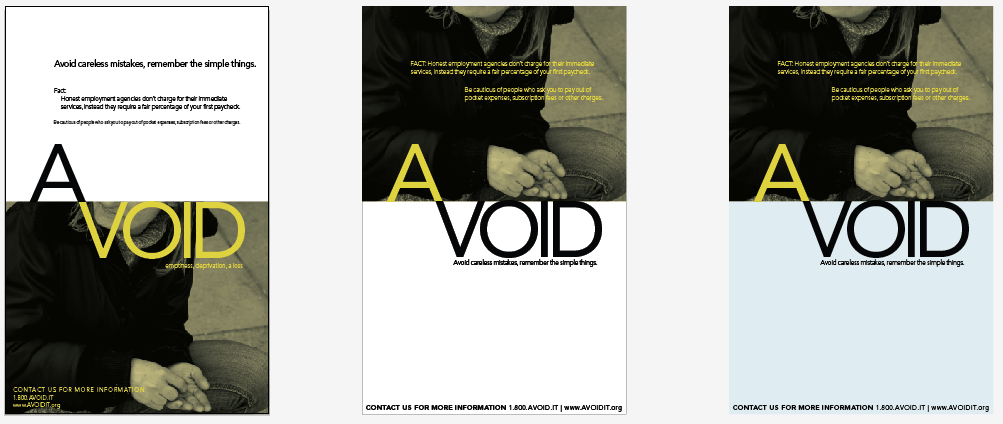


We ended up basing everything on the yellow and black versions (the bottom ones) and made the bus and the motion piece. We also changed the color and image based on the message. There was a lot more writing down on paper and ideas swirling in our head than there is physical artifacts so I didn't post them but instead did a lot of paraphrasing.
Subscribe to:
Posts (Atom)